re:markt
Designing a supermarket that stays operational when the power goes out.
“The projects arrived at extremely compelling, practically relevant results. The works have given us valuable impulses and opened fresh perspectives for our thinking and action with regard to strengthening societal resilience.”
Baden-Württemberg Ministry of Food, Rural Affairs and Consumer Protection
What this project is really about
This is not a product design project. It is an operating system for a building most people have never thought of as a system at all. The supermarket is critical infrastructure that was never designed to fail gracefully. re:markt asks: what if it was?
The design challenge was operational, not visual: a store that stays legible and enforceable for staff, customers, and logistics partners when the usual infrastructure is gone. Fair distribution not as an intention, but as a rule that holds without power, without internet, and with a crowd that is scared.
The answer is not a generator. It is a prepared switch: a second operating mode built into the store from the start.
95% of German supermarkets stop operating within four hours of a power outage; only 5% have backup generators. There is no standardized crisis mode: no distribution logic, no allocation rules, no plan for when normal operations collapse. What remains is improvisation under pressure, which means chaos.
Designed a dual-mode operating system built into the store from the start. Normal mode: standard retail. Crisis mode: floor converts to storage and distribution, a token-based issuance system replaces queuing, and a standardized re:box unit travels unchanged from producer to household across five distribution channels.
Selected for the HfG exhibition. Invited to present at the Baden-Württemberg Ministry of Food, Rural Affairs and Consumer Protection, a direct policy context. The Ministry endorsed the work in writing.
A system optimized for stability, not adaptability.
In normal conditions, supermarkets are extraordinarily efficient: lean inventory, just-in-time logistics, optimized shelf space. That efficiency is exactly the problem. It leaves no slack for disruption.
Power loss, supply chain interruption, or panic buying can break operations within hours. 89% of German households rely on supermarkets as their primary food source, so when stores stop functioning, even temporarily, the social consequences are immediate and disproportionate.
The gap is not a supply problem. It is a governance problem: no predefined crisis mode, no standardized logic for allocating goods under scarcity. Without rules, staff improvise. Improvisation under pressure produces chaos, and chaos costs the one thing a crisis needs most: trust.
Where the current system breaks.
I analyzed how the system fails along three dimensions: energy, cold chain, and human behavior. Each revealed a different layer of the same problem.
Energy failure is the most visible, but it is the trigger, not the cause. When power goes out, refrigeration fails first, then checkout, then communication. Staff lose the tools to manage demand. Customers, uncertain what will be available or for how long, default to panic: buying more than they need, arriving earlier, staying longer.
Cold chain failure compounds this. Perishables become unsellable within hours, so a store that enters a crisis with full shelves quickly holds less usable product than it appears to. The visible abundance is a liability.
Human behavior is the layer most easily overlooked. People behave predictably under scarcity: they hoard, they queue, they compete. A store without allocation rules has no mechanism to counter this. "First come, first served" is not a distribution strategy. It is the absence of one.
“Resilience is not improvisation. It is pre-defined operations that stay legible when infrastructure becomes unstable.”
Three things that had to be true at once.
The concept had to work under three conditions at once: limited energy, high and unpredictable demand, and staff under severe stress. Anything that required extensive training, complex technology, or new infrastructure to activate was not a solution. It was a dependency.
Three non-negotiables followed. First: fair distribution must be explainable. Allocation rules have to be simple enough that a customer understands them before entering the store, because rules that require interpretation get contested, and contested rules under stress create conflict.
Second: the system must survive without digital infrastructure. QR codes and NFC tokens work offline, and paper fallbacks exist for everything digital.
Third: compatibility with existing logistics standards. Custom packaging or rebuilt distribution infrastructure would make the concept undeployable at scale. The re:box had to fit into what already exists.
A store that operates in two modes.
re:markt is a normal supermarket that contains, within its existing footprint, a fully operational crisis distribution system. Activating it requires no external resources and no emergency decisions. It requires executing a plan that was already made.
In normal mode, the store works like any supermarket: open shelving, free movement, standard checkout.
In crisis mode, the transformation is physical and operational at once. Community and waiting areas expand at the perimeter, the sales floor shrinks toward the center, and storage grows to receive incoming re:boxes. Signage switches from advertising to orientation: what is available, in what quantity, and how it will be distributed.
The transition is not an emergency response. It is a mode change, like a building switching into its fire evacuation protocol. Except this one can hold for days, not minutes.

Infrastructure branding.
The visual system is not designed for marketing. It is designed for orientation and trust: signage, zoning, and communication in crisis mode work like public infrastructure, legible at a distance, interpretable under stress, authoritative without being aggressive.
Three mechanisms that make it enforceable.
A good concept is not enough. The system has to be operable by real staff, under real stress, without specialized equipment. Three mechanisms carry that load.
The re:box is a standardized unit that stays identical from producer to household: fixed dimensions, fixed weight, fixed contents. The producer packs it, the warehouse stores it, the store hands it over, the household carries it home. Keeping the unit stable across every handoff removes the failure points that appear when packaging changes between stages. Staff count boxes without opening them; households receive a predictable quantity.
Token-based issuance replaces "first come, first served." Each household receives a QR or NFC token and a pickup window: everyone with a token has guaranteed access, so there is no advantage to arriving early. Queue dynamics collapse, and staff control throughput predictably.
Zoning divides the space into entry, waiting, handoff, and exit, with controlled transitions between them. It shields staff from full crowd pressure and prevents the compression that leads to conflict. The markings are tape and signage, deployable in under thirty minutes.
Five ways to reach a household.
A single store cannot serve a whole neighborhood in a crisis. re:markt is not one point of distribution but the anchor of a network that uses existing infrastructure wherever possible.
The Hub is the operational center: it receives re:boxes, manages inventory, and dispatches to the other channels. Click & Collect lets households pre-order and pick up their re:box in a set time window without entering the full store.
Delivery brings re:boxes directly to households, prioritizing people with limited mobility, the elderly, and families with small children: those least equipped to navigate a crowded store in a crisis. Pop-Up stations, vehicle-based, cover neighborhoods without a Hub nearby.
DHL Station uses Germany's existing network of automated parcel lockers to distribute re:boxes without any additional staffing. A household picks up a re:box the way it picks up any parcel.
The channels activate selectively, not all at once. A local outage might need only Hub and Click & Collect. A regional failure activates all five.

What the numbers say.
The expected impact is predictability.
Clear allocation rules reduce conflict. Energy prioritization keeps critical systems running. Standardized logistics removes the fragile handoffs that break when packaging or process changes between stages.
The behavioral effect matters as much as the operational one. When people know what they can get, in what quantity, and when, panic behavior shifts to planning behavior. Crowds stabilize, pressure on staff drops, and trust in the supply system holds at exactly the moment it is most at risk.
The interface was never the screen.
I came into this project expecting to design an interface. I left it having designed a governance system.
In a crisis, the interface is the rules: how decisions are made, by whom, under what authority, with what fallback. The most important design work was the logic behind the token system, the zoning protocol, and the re:box specification. Getting those right gave the visual layer something real to communicate.
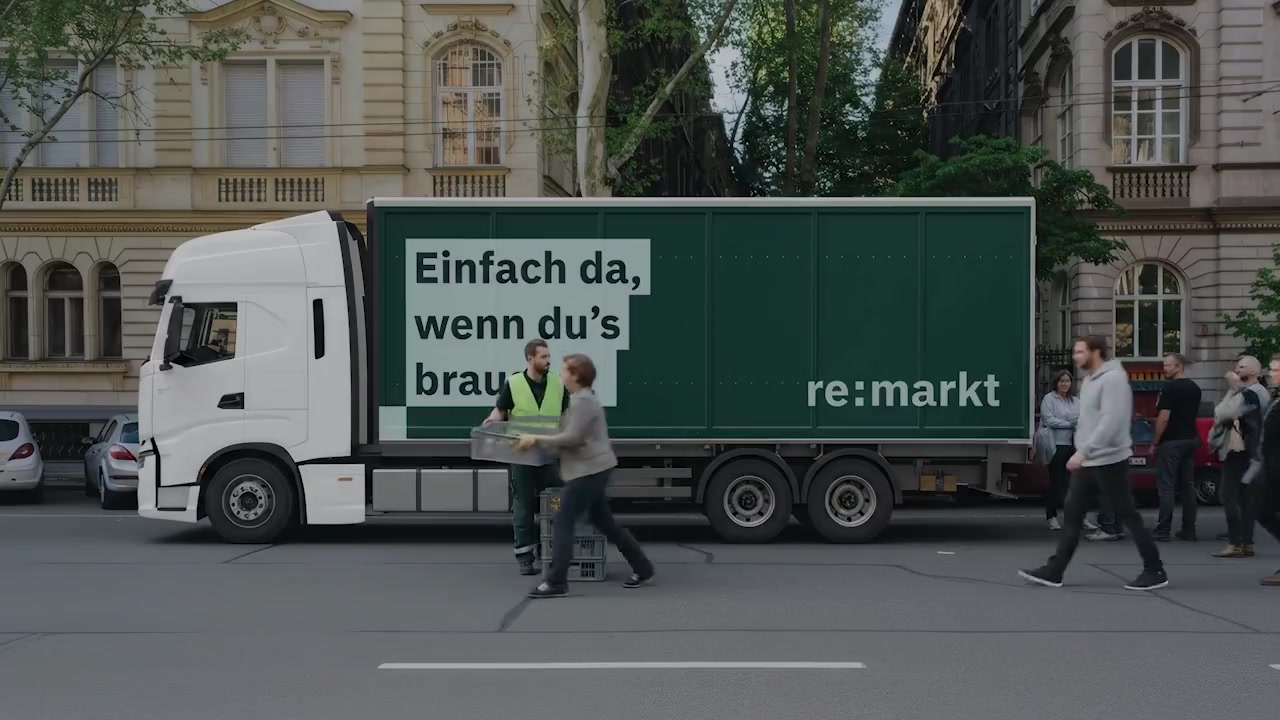
The AI-generated concept film for the exhibition taught a second lesson: generative tools did not find the narrative, they executed one we had already built.
Rule clarity is UX.
When infrastructure fails, UX becomes operational governance: clear modes, enforceable rules, communication that holds under stress.
Embrace Ambivalence
→Fast or slow. Digital or analog. Usually a brand has to pick one.