maya
The language gap in German care facilities doesn't start on the ward. It starts at home, months before the first shift.
What this project is really about
Germany will be short 350,000 nursing staff by 2034. The country's response, by necessity, is international recruitment. Thousands of care trainees arrive each year from the Philippines, Vietnam, Mexico, and elsewhere — qualified, motivated, and holding language certificates that say they're ready.
Most of them are not ready. Not because the certificates are wrong, but because the certificates measure the wrong thing. They measure classroom German. The workplace runs on something else: informal phrasing, shift handover shorthand, the exact words for a patient's pain level, small talk with a colleague at 6am.
maya does not try to teach German faster. It tries to change where and when language learning happens. The key insight came early in our research: trainees who live with people from their home country speak their native language every evening, every morning, every weekend. By the time they arrive at work on Monday, German has had zero hours of exposure since Friday. The workplace inherits a deficit that started at home.
maya intervenes upstream. It shapes the daily environment — the housing, the digital companion, the gradual linguistic shift — before the language problem becomes a dropout.
International care trainees arrive with valid language certificates but struggle with everyday communication — workplace phrasing, informal conversation, local knowledge. When staff spend their off-hours in native-language households, German gets no daily practice. Dropout rates are high. Each dropout costs Stiftung Liebenau €6,826 in direct costs alone. Germany is projected to be short 350,000 nursing staff by 2034.
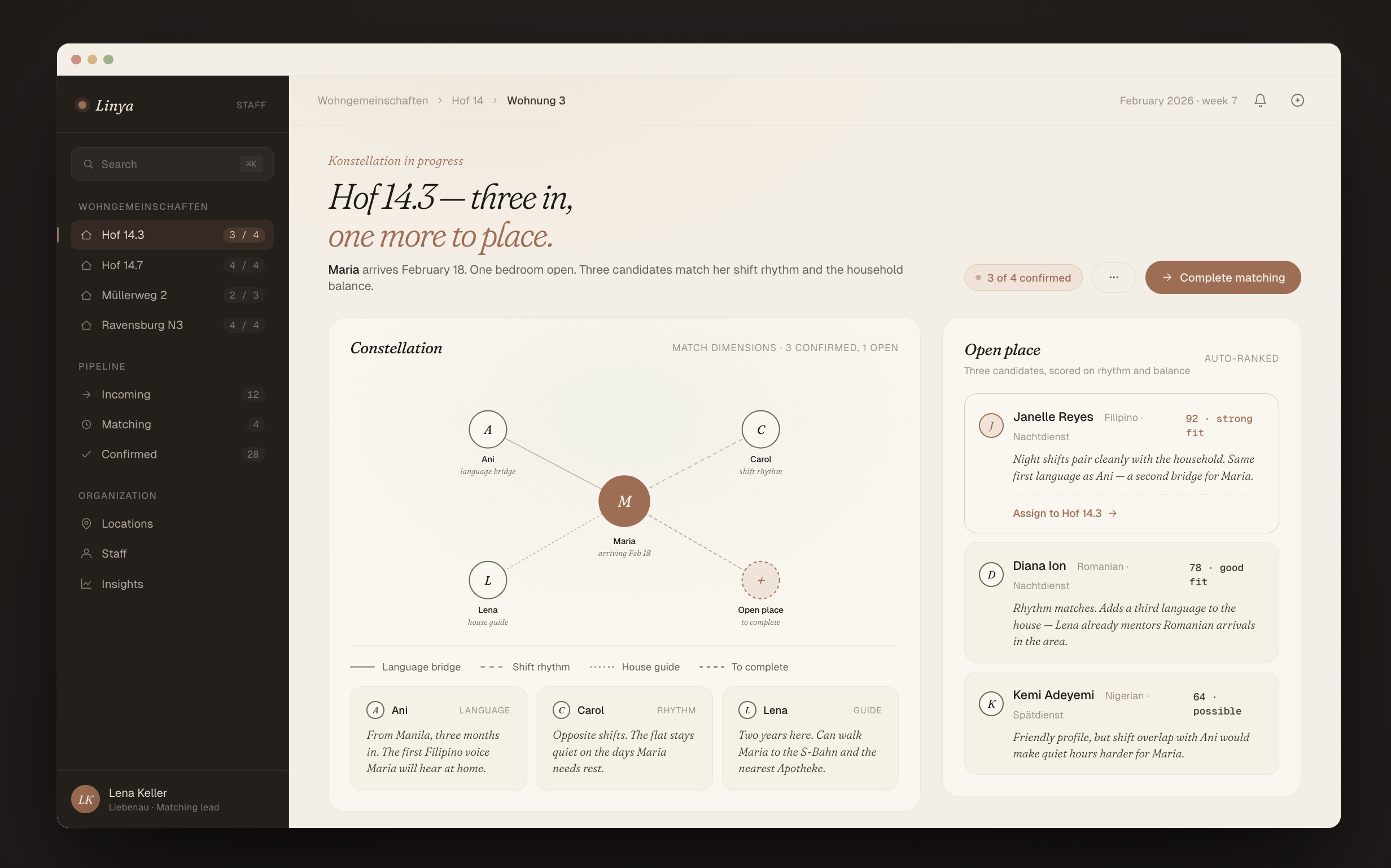
Designed a two-part system that addresses language at the source. First: a structured shared-living matching system that pairs international trainees with German-speaking housemates based on language level and experience — turning daily life into passive language exposure. Second: a single AI assistant that starts in the trainee's native language and shifts gradually toward German as confidence grows, covering onboarding, daily life, and workplace basics.
Three linked prototypes delivered: shared-living matching dashboard, onboarding assistant (maya 1.0), and everyday assistant with adaptive language shift. System designed for Stiftung Liebenau's operational constraints: data privacy, cultural sensitivity, and adoption in a high-workload environment.
A structural crisis with a solvable upstream cause.
Stiftung Liebenau is one of Germany's larger social welfare organizations — over 8,900 employees across care facilities, residential services, and social programs. Like most operators in the sector, they depend heavily on international recruitment to meet staffing demands that domestic supply cannot fill.
The briefing was specific: design a KI-based system for multilingual communication in a sensitive care context. Data privacy, cultural sensitivity, and adoption from day one were the hard constraints. The system had to feel safe and respectful — not surveillance, not enforcement, not a workaround for a broken hiring pipeline.
We went in expecting a translation problem. We found something more interesting: a timing problem.
The language failures were not happening because trainees lacked capability. They were happening because capability that exists in a classroom does not automatically transfer to a care environment. Trainees knew the grammar. They did not know how to tell a colleague at shift handover that a patient had been agitated all night. They did not know how to navigate the bureaucracy of registering at the local Einwohnermeldeamt. These are not gaps you can close with a course. They close with time, exposure, and a daily environment that makes practice unavoidable.
What we heard in the hallways.
We conducted desk research, focus group interviews, on-site visits to Liebenau facilities, and interviews with HR leadership, care coordinators, practical supervisors, and care workers — both from Liebenau and one external operator.
Trainees avoided asking questions. Not because they didn't have them — but because asking felt like admitting failure. "They get lost in daily life often," one care coordinator told us. "They don't know how processes here work, and they rarely dare to ask." The social cost of asking a question was too high. So gaps compounded silently.
Staff carried the overhead. "You explain things again and again," another interviewee said. "It costs time and quickly leads to misunderstandings in the team." This was not occasional. It was structural — a recurring coordination tax that came with every new international arrival.
The housing insight was the one that reoriented everything. "Many live only with people from their home country," one HR manager said. "So German simply stays out of daily life." The language that matters most — informal, everyday, low-stakes German — was getting zero practice during the hours when practice was most possible.
“On paper the language level often fits. But in the daily work reality, you notice it's not enough.”
Interview, Stiftung Liebenau care coordinator
Language is the upstream lever.
The problem map I built after research showed six distinct problem areas: staff overhead from repeated explanations, housing scarcity limiting recruitment capacity, missing local knowledge in daily life, onboarding overload from bureaucracy, dropout from repeated language test failures, and the core pattern of trainees reverting to their native language in off-hours.
All six problems had language as a root cause or accelerant. Solve the language situation first — especially the off-hours language situation — and most of the other problems become smaller.
This shaped our design direction completely. We were not designing a translation tool. We were designing an integration system whose entry point was daily life, not the workplace.
Three principles guided every subsequent decision. First: mutual learning — peer exposure works better than instruction, and it costs nothing extra if the housing is already there. Second: help for self-help — the goal is independence, not dependency on a chatbot. The assistant should be working itself out of a job. Third: everyday independence as the foundation — if a trainee can navigate their daily life with confidence, the workplace becomes easier.
Trust is the feature.
In a care context, adoption depends entirely on whether the tool feels safe. Privacy constraints, cultural tone, and escalation logic were not UX considerations — they were product requirements. A tool that staff or trainees do not trust will not be used. A tool that is not used solves nothing.
Shape the housing. Then shape the language.
maya is a two-part system. The parts are designed to work together, but each solves a distinct problem.
The first is the shared-living matching system. Housing at Liebenau is managed centrally — this is both a constraint and a leverage point. By structuring who lives with whom, the organization can engineer daily language exposure without any additional program, class, or cost. A trainee who lives with a German-speaking second-year apprentice gets German practice at dinner, on the way to work, and in every small daily interaction. This is not language instruction. It is language immersion by design.
The matching matrix works on two axes: time in Germany (experience with the context) and language level. Groups of three to six people are formed to balance the distribution — at least one person with stronger German capability in every unit. The HR dashboard manages this systematically, replacing the informal, ad-hoc housing assignments that currently happen without any matching logic.
The second part is maya 1.0: an AI assistant that covers the first phase of a trainee's journey. It begins in the trainee's native language — because arriving in a foreign country is already overwhelming, and adding language pressure at that moment is counterproductive. Then, as the trainee gains confidence, the assistant gradually shifts toward German.
In phase one, the assistant covers onboarding questions, local navigation, bureaucratic processes, and daily life basics. It is available before arrival, so a trainee can begin to understand their new context before they step off the plane. It is intentionally scoped away from medical and clinical content — trust must be established before scope can expand.

One assistant, two phases, a gradual shift.
The matching system and the assistant are connected by a shared logic: start where the person is, then shift gradually toward where they need to be. Neither system forces progress. Both systems make progress feel natural.
The matching matrix runs on six levels, combining two dimensions — length of time in Germany and German language level. A Level 6 is a German-speaking apprentice in their second or third year who knows the routines, the local area, and the facility. A Level 1 is an international trainee who arrived last week. The matrix generates balanced household compositions: every group has at least one person who can informally answer the questions that don't get asked at work.
The assistant's language shift works on the same principle. It does not tell the user "you should practice German now." It progressively introduces German words, then phrases, then responses — embedded in the natural flow of a conversation that remains comfortable and comprehensible. The goal is passive acquisition becoming active use, at a pace that builds confidence rather than pressure.
The Liebenau provider dashboard gives HR teams visibility into matching quality, language progression signals, and recurring support patterns. This is not surveillance — it is aggregate signal. If many trainees in a given cohort are asking the same questions, that is information the organization can act on structurally rather than handling case by case.
Three prototypes, three phases, one financial case.
The semester outcome is a three-phase rollout, costed end-to-end. Each phase is a working prototype with its own break-even logic — the deliverable is the case for why an organization should operate it, not just what it looks like.
Phase 01 is WG-Matching: a provider-facing dashboard that generates balanced household compositions from a six-level matrix of language proficiency and time-in-Germany. Operable on day one, no AI required. Phase 02 is maya 1.0, the onboarding assistant scoped strictly to private-life context — supermarket, transit, bureaucracy — in the trainee's native language. Phase 03 is maya 2.0, where the assistant shifts language incrementally toward German and opens a scoped workplace path, separated cleanly from private-life context.
The financial model resolves four inputs — 1h/week supervisory overhead per trainee, 45 effective working weeks, €35/h fully loaded care-worker cost, and BIBB's €6,826 direct cost per dropout — into a per-trainee monthly exposure of €160–€188. That is the price ceiling under which maya is economically additive.
Market sizing followed the same discipline. TAM: 250,000–300,000 international care workers in Germany. SAM: 80,000–120,000 employed by large Träger where centralized housing and HR systems exist. SOM: 100–300 trainees for the Liebenau pilot. Each phase scales on the same architecture.
The framing is a model, not a measured outcome. It exists to communicate order-of-magnitude — that the problem is large enough to justify investment at a defensible price point — not to overstate what a semester prototype can prove.
“Combined exposure per international trainee, per month: €160 (conservative) to €188 (normal). Anything maya costs to operate below that ceiling pays for itself in avoided cost alone — before any improvement in integration outcomes is counted.”


What changes if this works.
The expected impact operates on two levels.
For the individual trainee, maya reduces the social cost of not knowing something — the anxiety of asking, the embarrassment of confusion, the compounding isolation of navigating a new country alone. Less uncertainty in daily routines means more cognitive capacity available for work. More confidence at home means less avoidance behavior at work.
For the organization, the benefit is structural. Reduced staff overhead from repeated explanations is the most direct effect — and the most measurable. Better housing matching also reduces interpersonal friction in shared living, which reduces a category of conflict and discomfort that currently has no systematic response.
The economic framing is a simplified model, not a measured outcome. We used it to communicate order of magnitude — to show that the cost of the problem is large enough to justify investment in a solution, without overstating what we could prove in a semester prototype.
What shifted in how I think about systems.
The biggest shift for me was understanding that fixing the downstream symptom — the language failure at work — required intervening upstream in the living situation. That is not an obvious design move. It requires stepping back far enough from the immediate problem to see what is feeding it.
The trust constraint was the second major learning. In care contexts, every design decision carries a different weight than it does in a consumer product. The question is never just "does it work?" It is "will people use it, and will using it feel safe?" Privacy is not a legal checkbox. Cultural tone is not a UX detail. These are the features — the things that determine whether the system gets adopted at all.
If I were building the next version, I would separate the private-life and workplace assistants explicitly. Right now they exist in one interface, and that ambiguity creates uncertainty about what the assistant knows and what it shares with the employer. A cleaner boundary would build more trust faster.
Language is the upstream lever.
Solve it in daily life first and you unlock onboarding, retention, and trust simultaneously. The problem doesn't start at the workplace — and the solution shouldn't either.
odo
→Every route planner gives you a path. None of them know what kind of ride you're in the mood for.